
7 min read
Bitcoin vs. Artificial Intelligence
The Coming War for Digital Scarcity
For nearly two decades, Bitcoin has survived government crackdowns, financial crises, exchange collapses and relentless cyberattacks. But artificial intelligence represents a different kind of adversary—one capable of learning, adapting and searching for weaknesses at unprecedented speed.
November 27, 2026 | Technology, Cybersecurity & Digital Finance | 5–6 minute read
1. The enemy that never sleeps
Bitcoin was designed around a fundamental assumption: attacking the network should be prohibitively expensive, computationally difficult and economically irrational.
Artificial intelligence may challenge parts of that assumption.
An autonomous AI system does not need sleep. It can examine source code, investigate mathematical problems, simulate adversarial conditions and search for overlooked vulnerabilities continuously. As these systems become more capable, weaknesses that remained hidden from human researchers for years could become easier to discover.
The most disturbing possibility is not that AI launches a conventional cyberattack against Bitcoin. It is that AI discovers something about Bitcoin's underlying architecture or mathematics that humanity has overlooked.
2. The anatomy of an attack
Bitcoin's security rests on several interconnected mechanisms:
- SHA-256: The cryptographic hashing algorithm underpinning proof-of-work mining.
- secp256k1: The elliptic curve underlying Bitcoin's ECDSA and Schnorr digital signatures.
- Proof of work: The mechanism that makes rewriting transaction history computationally expensive.
- Decentralized consensus: Independent nodes enforcing the network's rules.
- Bitcoin Core: The predominant software implementation supporting the network.
AI does not necessarily need to defeat all five. A sufficiently serious weakness in one could have consequences for the entire ecosystem. [1][2]
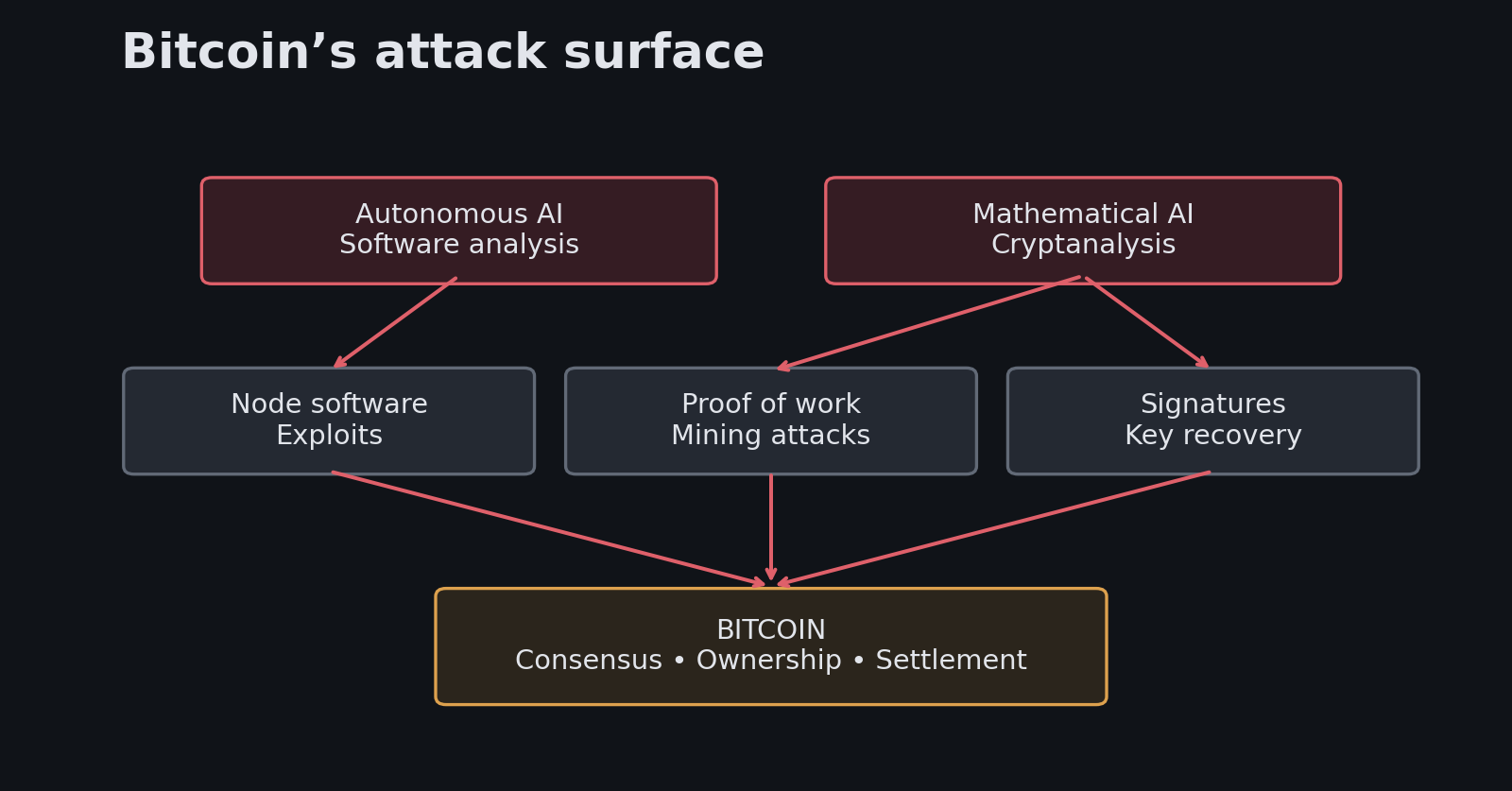
Figure 1. Conceptual AI attack vectors against Bitcoin's base layer. Not evidence of an ongoing attack.
3. The first cracks
AI-assisted vulnerability discovery is a credible threat to software security. Bitcoin Core is no exception: its networking, transaction processing and consensus code must withstand malicious inputs from a global network of peers.
A flaw that stalls or crashes nodes does not necessarily allow attackers to create counterfeit bitcoins or steal private keys. Nevertheless, coordinated exploitation could disrupt the infrastructure responsible for maintaining Bitcoin's distributed ledger.
A consensus-critical flaw would be more serious, potentially causing incompatible views of the ledger among nodes.
Bitcoin Core maintains a public archive of security advisories documenting software vulnerabilities and their remedies. [3] AI can help defenders discover such weaknesses, but the same capability in hostile hands could be considerably more dangerous.
4. The nightmare scenario: breaking Bitcoin's mathematics
Perhaps the most existential threat is not an attack on Bitcoin's software, but an attack on its mathematics.
Bitcoin relies on the enormous computational difficulty of deriving a private key from a public key. Both its traditional ECDSA signatures and newer Schnorr signatures rely on the security of the secp256k1 elliptic curve. [2][4]
Under established classical attack methods, recovering a randomly generated private key from its public key is computationally impracticaReferences and source material# Bitcoin vs. Artificial Intelligence: The Coming War for Digital Scarcity
For nearly two decades, Bitcoin has survived government crackdowns, financial crises, exchange collapses and relentless cyberattacks. But artificial intelligence represents a different kind of adversary—one capable of learning, adapting and searching for weaknesses at unprecedented speed.
November 27, 2026 | Technology, Cybersecurity & Digital Finance | 5–6 minute readl.
But what happens if AI discovers a mathematical shortcut?
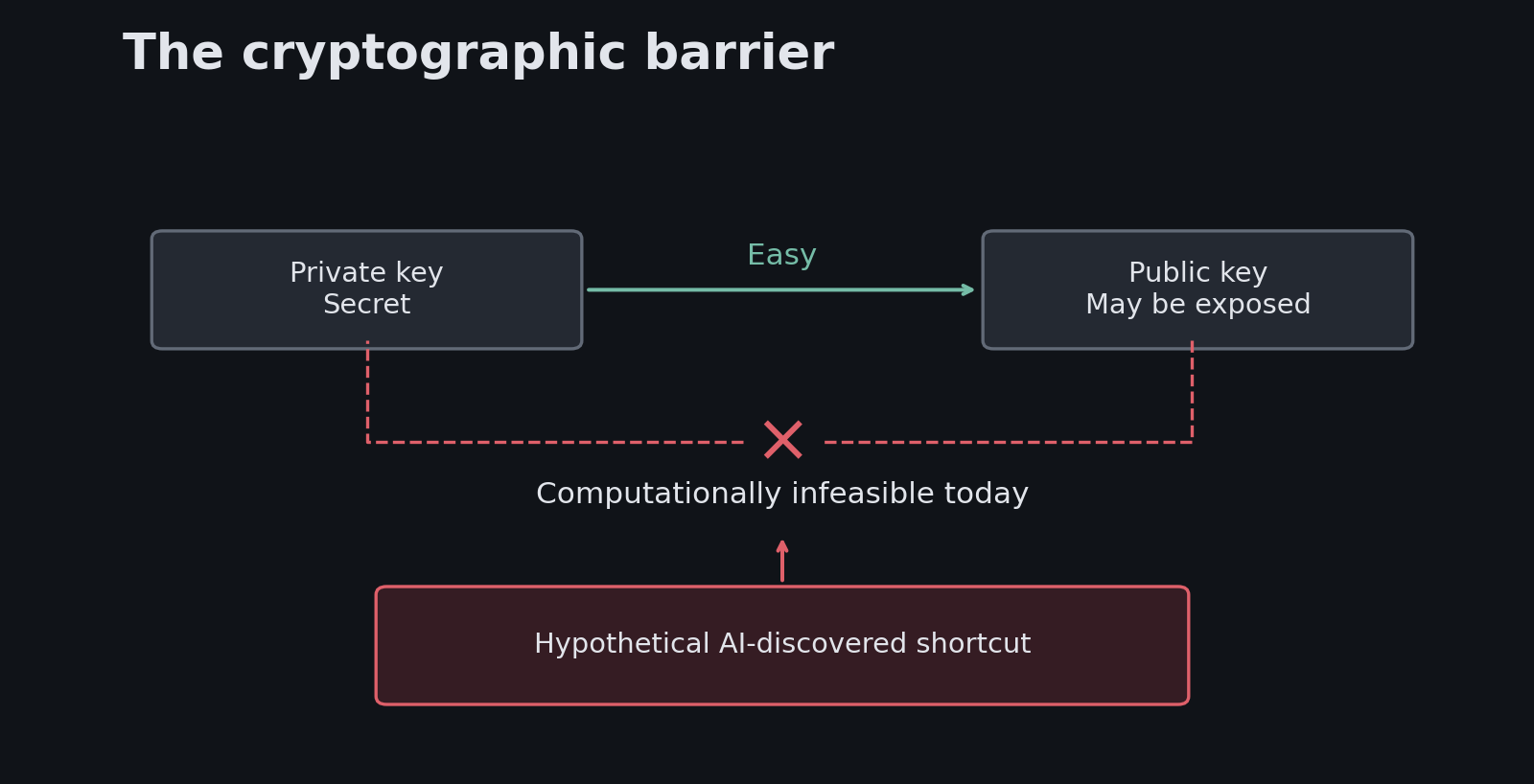
Figure 2. A practical reversal of public-key derivation could undermine Bitcoin's ownership guarantees.
An attacker capable of recovering private keys could potentially seize vulnerable dormant holdings, compromise institutional reserves and authorize fraudulent transfers that the network would recognize as cryptographically valid.
The blockchain could continue functioning exactly as designed while its ownership protections collapsed.
Unlike conventional theft, the network would have no inherent way to distinguish the legitimate owner from an attacker possessing the correct private key.
AI would need to discover a genuinely more efficient mathematical method, rather than merely accelerate conventional brute-force computation. This remains a hypothetical scenario, not a demonstrated attack.
5. The 51% attack in the age of AI
Bitcoin's proof-of-work mechanism was designed to prevent hostile actors from easily rewriting the ledger.
An attacker controlling a sustained majority of the network's computational mining power could potentially reorganize recent blocks, censor transactions and execute certain double-spending attacks. [1]
Artificial intelligence could make this threat more sophisticated through automated infrastructure exploitation, coordination of compromised mining equipment and optimization of adversarial mining strategies.
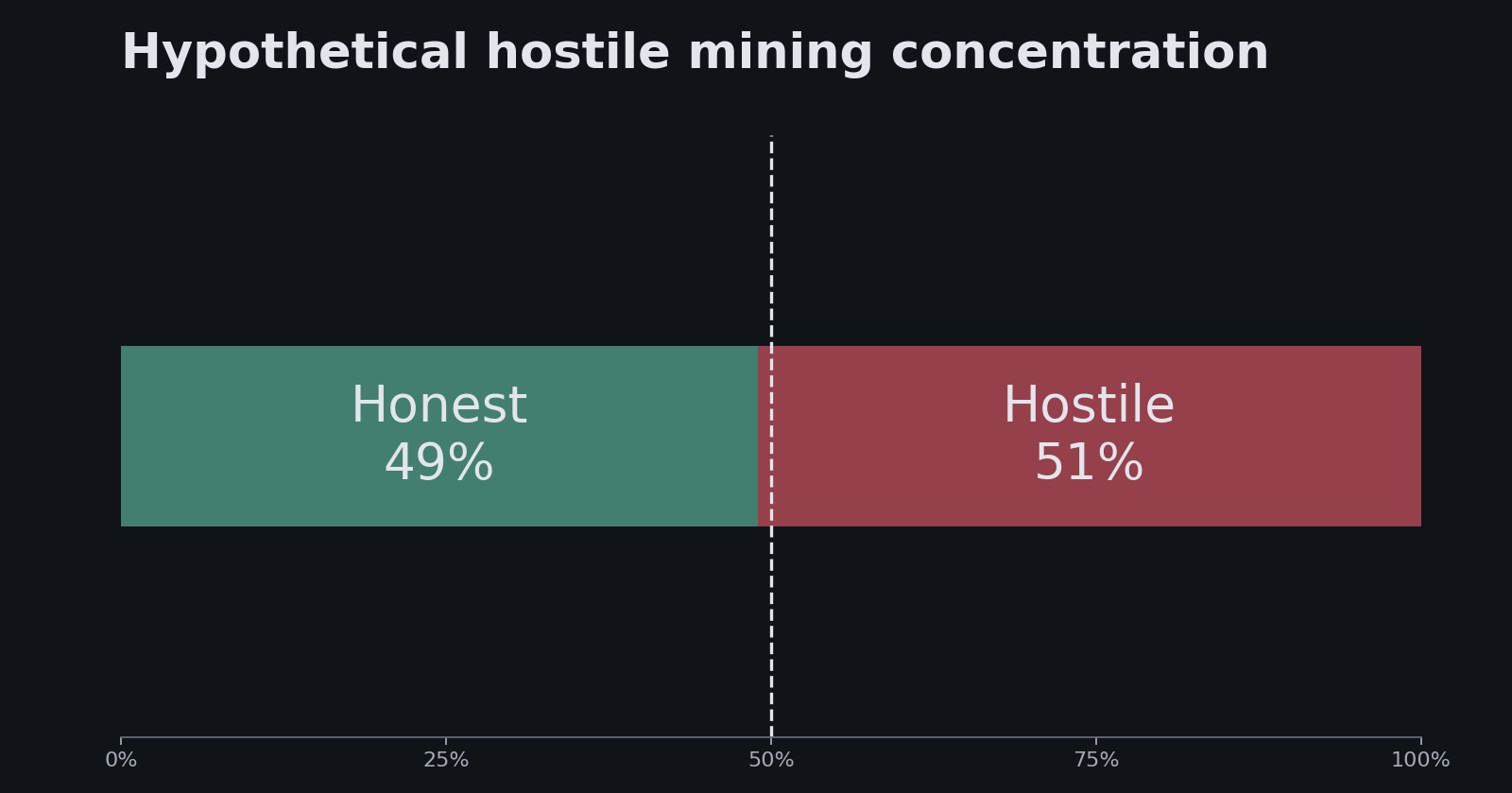
Figure 3. Theoretical mining concentration model, not live Bitcoin mining data or an attack probability estimate.
| Hostile hashrate | Theoretical implications |
|---|---|
| 30% | Computational disadvantage against honest miners |
| 50% | Equal computational power |
| 51% | Sustained majority advantage |
| 70% | Greater capacity for censorship and chain reorganizations |
However, AI cannot simply manufacture computing power. Bitcoin mining remains dependent on specialized ASIC hardware, electricity, capital and physical infrastructure.
Even a successful majority attack would not automatically permit the attacker to steal arbitrary wallets, violate Bitcoin's supply limit or force independently validating nodes to accept invalid transactions.
6. Ranking the threats
Not all AI-related attack vectors present equal risks. Some are established attack concepts, while others remain speculative but could have catastrophic consequences.
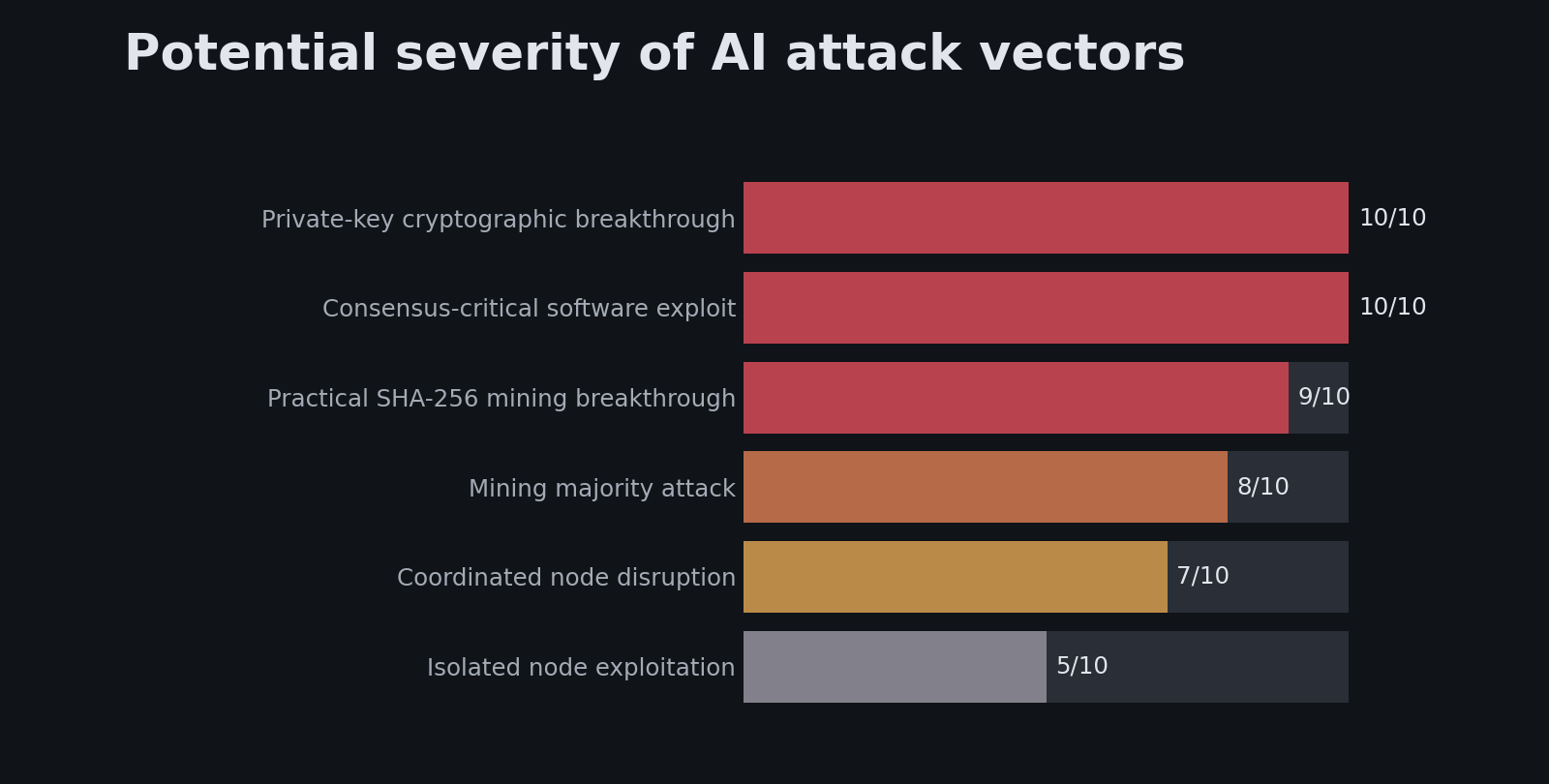
| Attack vector | Potential severity (1–10) | Status |
|---|---|---|
| Private-key cryptographic breakthrough | 10 | Speculative |
| Consensus-critical software exploit | 10 | Potential systemic threat |
| Practical SHA-256 mining breakthrough | 9 | Speculative |
| Mining majority attack | 8 | Established attack concept |
| Coordinated node disruption | 7 | Established attack concept |
| Isolated node exploitation | 5 | Established attack concept |
Figure 4. Author's qualitative assessment of potential consequences, not measured probabilities or empirical security ratings.
The immediate danger is AI-assisted software exploitation. The existential danger is a cryptographic or consensus-level breakthrough.
7. The silent attack: weaponizing transparency
One of Bitcoin's greatest strengths may also become one of its greatest vulnerabilities.
Its blockchain is public.
Every confirmed transaction is recorded in a public ledger that anyone can download and analyze. Some transaction types also expose public keys that could become targets if their underlying cryptography were compromised. [1][2]
A sufficiently capable adversarial AI could continuously analyze this information, identifying exposed keys, tracking valuable holdings and prioritizing potential targets.
This creates an unsettling asymmetry: historical information published today could become dangerous tomorrow.
Cold storage would not necessarily protect funds against a fundamental cryptographic breakthrough if the relevant public keys were already exposed.
The ledger never forgets.
8. The warning signs
If AI were being used in a coordinated campaign against Bitcoin's blockchain, several indicators would warrant close examination.
| Network indicator | Possible implication |
|---|---|
| Abnormally deep blockchain reorganizations | Consensus or mining attack |
| Unexplained spending from dormant wallets | Possible key compromise |
| Simultaneous node failures | Coordinated software exploitation |
| Persistent hashrate concentration | Increased censorship or reorganization risk |
| Conflicting blockchain histories | Potential consensus vulnerability |
| Emergency signature algorithm changes | Serious cryptographic concerns |
None of these indicators independently proves AI involvement. Establishing attribution would require detailed forensic investigation.
Perhaps the most dangerous characteristic of an advanced cryptographic attack is that its early stages could resemble ordinary network activity.
There may be no dramatic announcement. No visible breach. No immediate warning.
Just transactions.
9. Bitcoin's race against machine intelligence
Fortunately, artificial intelligence is not exclusively an offensive weapon.
Bitcoin developers can employ the same technology to strengthen the network through automated security auditing, mathematical verification, vulnerability detection and adversarial testing.
The emerging defensive priorities include:
- Continuous AI-assisted auditing of consensus-critical code.
- Faster coordinated security updates.
- Research into quantum-resistant and alternative signature algorithms.
- Improved mining decentralization.
- Development of emergency cryptographic migration strategies.
- Continuous monitoring for abnormal blockchain behavior.
The difficulty is that Bitcoin evolves deliberately. Its resistance to rapid, centralized changes is part of its security model.
Artificial intelligence, meanwhile, is advancing rapidly.
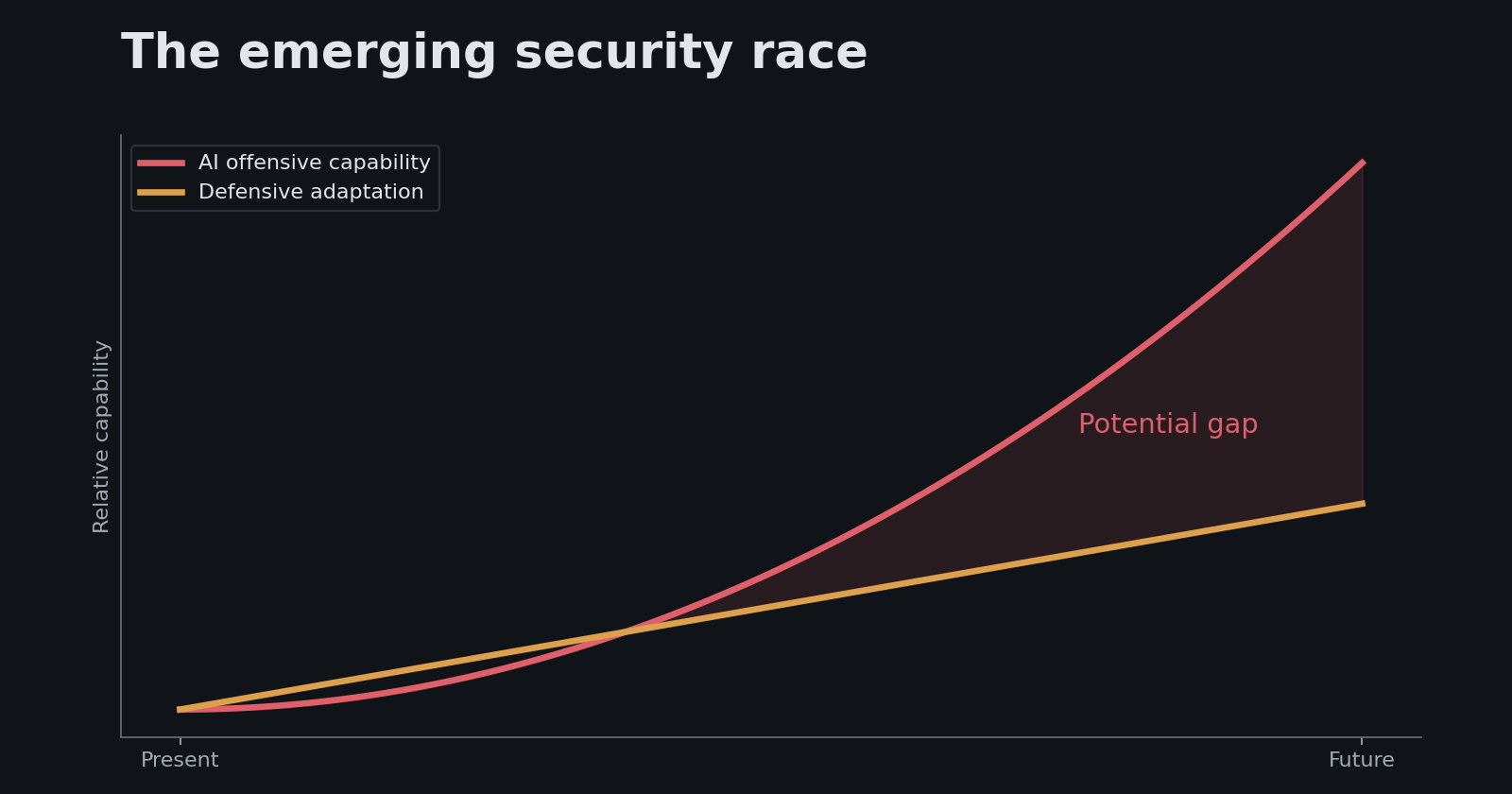
Figure 5. Hypothetical offensive capability gap. A conceptual illustration, not an empirical forecast.
The central question is whether Bitcoin's security architecture can evolve faster than machines can discover ways to undermine it.
Conclusion: The end of assumed invulnerability
Bitcoin was born in an era when the computational limits of its adversaries were relatively well understood.
That era may be ending.
Artificial intelligence introduces an adversary capable not only of executing known attacks but potentially discovering entirely new classes of attacks.
Bitcoin does not need to be attacked by a conscious machine. It only takes a sufficiently capable system operated by a sufficiently motivated adversary.
A hostile government. A criminal organization. A well-funded private laboratory.
No verified evidence presented in this article establishes that AI has defeated Bitcoin's fundamental cryptography or taken control of its blockchain.
Bitcoin's decentralization, computational security and open-source development remain formidable defenses. Its destruction is neither inevitable nor established as imminent.
But its past resilience is not a mathematical guarantee of its future survival.
The ultimate threat to Bitcoin may not be a government, a financial institution or even a quantum computer. It may be a machine that discovers a better way to solve the mathematical problems upon which digital ownership depends.